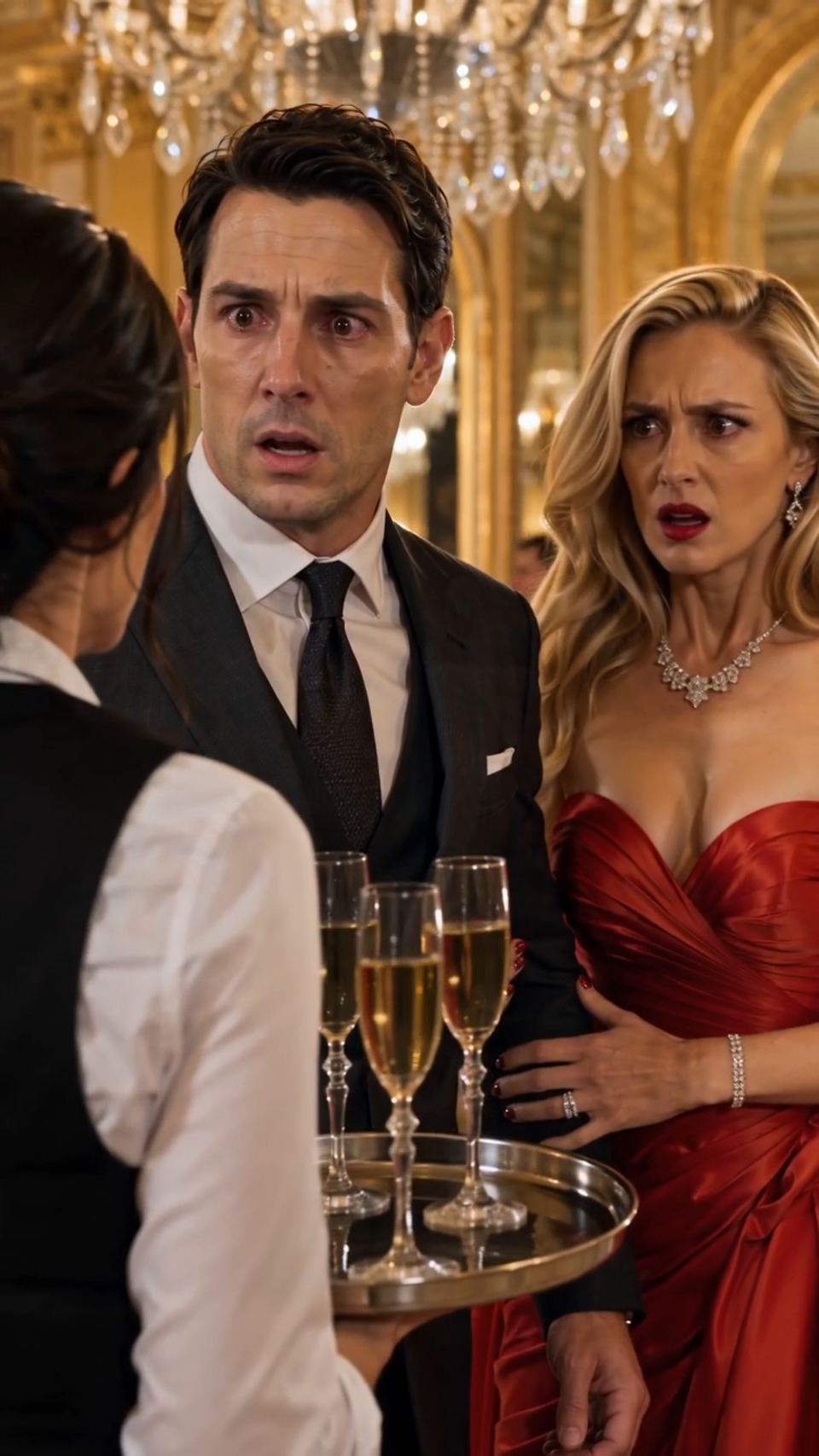
“Because she’s not just a waitress. She’s my wife.”
The words hit the ballroom like a dropped glass.
Claire froze with her tray trembling in her hands. The champagne inside the flutes quivered, but somehow none of it spilled. Around her, the guests in silk and diamonds stared as if she had turned into smoke.
Drew Mercer stepped away from the blonde woman clinging to his arm and walked toward Claire.
He had once been the man she married in a courthouse with no flowers, no guests, and no promises except survival. Now he stood under a crystal chandelier in a room full of people who clearly believed he belonged somewhere else.
The blonde woman looked outraged. “Your wife?”
Claire’s face burned. “Drew, don’t.”
But he was already close enough to see the tears she was trying not to shed.
A man near the orchestra lowered his voice. Another guest whispered Claire’s name like it was a scandal.
Then Drew said, quietly but clearly, “You left without telling me why.”
Claire’s throat tightened. “I had no choice.”
Before Drew could answer, an older woman in pearls stepped forward from the edge of the crowd.
She was wearing the Mercer family emerald pin.
And Claire went pale, because this was the first person from Drew’s past who had ever known her name.
The woman with the emerald pin did not look surprised.
That frightened Claire more than the shouting had.
“You are Claire Bennett,” she said. Not a question. “You were supposed to be gone.”
Drew turned sharply. “You know her?”
The woman’s mouth tightened. “I know enough.”
Claire had not seen Eleanor Mercer in six years. Not since the night she packed one bag, left Drew a single note, and disappeared before dawn. Back then, she had been young enough to believe love could survive silence. Then life had taught her otherwise.
Now Eleanor stood in the center of the gala like a judge.
“You work here?” Eleanor asked. “As a server?”
Claire lifted her chin. “Yes.”
Drew stared at her uniform. “Why?”
Because she had bills. Because she had a mother in a care home. Because pride did not pay rent. But none of that mattered now.
“That isn’t the issue,” Claire said.
“Oh, it is,” said the blonde woman, whose name Claire suddenly remembered as Vivienne Hale. “If she really is your wife, why are you here with me?”
That question landed harder than she meant it to.
Drew looked from Vivienne to Claire. “I came tonight because Eleanor told me you would be here.”
Claire blinked. “What?”
Eleanor’s eyes did not soften. “I asked him to come. I needed proof.”
The music had resumed, but no one was dancing now. People were pretending not to listen while listening to everything.
Claire took one careful breath. “Proof of what?”
Eleanor reached into her clutch and removed a folded letter, yellowed at the edges.
It was addressed in Claire’s handwriting.
Claire had not seen that envelope since the night she vanished.
And on the back, in another hand, was a sentence that made her knees weaken.
“Do not tell Drew about the baby.”
Claire could not hear the orchestra anymore.
The room tilted around her, and for one terrible second she thought she might drop the tray and the whole evening with it. Drew caught her elbow before she fell.
“Baby?” he said, his voice rough. “What baby?”
Claire pulled away as if his touch burned. “Not here.”
Eleanor’s face had gone rigid. “You had no right to keep it from him.”
“I had every right,” Claire snapped, and the sharpness in her own voice startled her.
She had spent years learning how to survive by being small. Quiet. Useful. Invisible. But this was not a night for silence anymore.
Drew followed her into a side hallway lined with gilt mirrors and soft lamps. The noise of the gala dulled behind the doors. For a moment, they were alone.
“Tell me the truth,” he said.
Claire looked at the letter in Eleanor’s hand. Her own handwriting stared back at her like a ghost.
Six years ago, Drew had just been hired for the job that would change his life. Claire had been working double shifts at a bakery, trying to care for her mother and hide her fear of what the future would do to them. Then she got pregnant. Then she learned Drew’s father was already pressing him toward another woman, another life, another path.
Worse, Claire had been told something about Drew that she never confirmed. Something she still hated herself for believing.
“I left because I thought you chose her,” she said.
Drew shook his head. “Vivienne? I never chose Vivienne.”
“Then why did your family tell me to disappear?”
He went still.
That answer mattered. She saw it in his face.
Before he could speak, Eleanor stepped into the hallway. “Because if you stayed, the baby would have ruined everything.”
Claire stared at her. “My baby was not a problem to be managed.”
“No,” Eleanor said softly. “It was the one thing your husband was willing to lose his inheritance over.”
Drew’s eyes widened.
Claire turned to him, confused, angry, and suddenly afraid of what else might be true.
Then Eleanor handed him the second page of the letter.
It was not Claire’s handwriting.
It was a medical report.
And the name on it was Claire’s mother.
Claire read the report twice before the words made sense.
Her mother, Anne Bennett, had been diagnosed with advanced heart failure six years ago. The treatment had cost more than Claire could pay. The report showed a private payment. Full coverage. Anonymous donor.
Claire looked up slowly. “You paid for her care?”
Eleanor’s eyes flickered. Not with guilt. With something close to grief.
“I did,” she said. “But not for the reason you think.”
Drew stared at her. “You knew Claire was pregnant.”
“I knew more than that.”
The hallway seemed too small now. Too bright. Claire could hear her own pulse.
Eleanor drew a breath. “Your mother came to me. She said you were terrified and alone. She asked me to protect your future, because she believed the child would drag you into a life neither of you could survive.”
Claire shook her head. “No. My mother would never say that.”
“She said it because she was dying,” Eleanor replied. “And because I told her the truth. I told her Drew’s father planned to use your marriage to force him into a financial arrangement with Vivienne’s family.”
Drew turned sharply. “That’s what this was?”
Vivienne had followed them after all, pale now and furious. “You make it sound as if I was the villain.”
“You were part of it,” Eleanor said.
Vivienne flinched. For the first time, her arrogance cracked. “I was nineteen. My father told me Drew would lose everything if he stayed with Claire. I believed him.”
Claire looked at her, stunned by the honesty.
Drew said nothing. He was staring at the medical report.
“There’s more,” Eleanor admitted. “Your child was born in another state. The adoption papers were filed the same week Claire left.”
Claire’s breath stopped.
“I never gave a child up,” she whispered.
Eleanor handed her a final page.
It was a birth certificate.
Under “Mother,” it said Claire Bennett.
Under “Father,” it said Drew Mercer.
And at the bottom, in a small nurse’s stamp, was the name of the hospital where Claire’s mother had died.
Claire felt her whole life split open.
“If the baby wasn’t adopted,” Drew said slowly, “then where is our child now?”
Eleanor closed her eyes.
And Claire realized with cold certainty that someone in this family had lied about more than love.
The answer came from the most unexpected person in the room.
A teenage server, no older than sixteen, had been standing near the door through most of the confrontation. Claire had noticed her earlier because she kept staring at the floor, clearly terrified of the wealthy guests.
Now the girl stepped forward.
“I think I know,” she said.
Eleanor turned white. “Lily, this is not your place.”
But Lily held up a folded photograph with trembling fingers.
It showed a small boy, maybe six years old, standing beside a piano bench in a modest house. On the back was written: “Daniel Bennett Mercer, age 6.”
Claire made a sound she did not recognize as her own.
Drew took the photo and stared at it. His hands shook. “This is my son.”
Lily nodded. “He lives with my aunt. She works at the hospice where your mother stayed. She said the boy was brought there years ago after his father disappeared and his mother got sick.”
Claire looked at Eleanor. “You knew.”
“I was trying to keep him safe,” Eleanor said, and for the first time she sounded old.
The truth came apart in pieces after that. Drew’s father had paid to hide the pregnancy. Claire’s mother, desperate and dying, had signed temporary guardianship papers she did not understand. Eleanor had let it happen because she believed Drew would be destroyed by scandal. Vivienne’s family had walked away once the money was secured. Everyone had chosen fear, and a child had paid for it.
Drew set the photograph down carefully.
“No more lies,” he said.
They found Daniel that night at the hospice, asleep in a small room with a baseball cap on the bedside table and a sketch of a woman with dark hair tucked under his pillow. He woke slowly, wary at first, then stared at Claire as if he had seen her in dreams.
“Mom?” he whispered.
Claire knelt beside the bed and cried for the first time in years.
Not from shame now.
From relief.
A month later, Claire no longer wore the black-and-white uniform. She sat at a kitchen table in a small rented house with Drew, Daniel, and a stack of school forms between them. Eleanor visited on Sundays. Vivienne wrote a letter of apology that Claire did not answer right away. She was learning that forgiveness did not have to be rushed to be real.
Drew held Claire’s hand across the table.
“You should have trusted me,” he said softly.
“I know,” Claire answered. “And you should have come looking.”
He smiled, tired and tender. “I am now.”
On the windowsill sat the old yellowed letter and the photograph Lily had found.
One had nearly destroyed them.
The other had given them back their son.
And when Daniel laughed in the next room, Claire finally understood that sometimes the truth does not arrive to punish you.
Sometimes it arrives to bring you home.
Để lại một bình luận