“What on earth are you doing?”
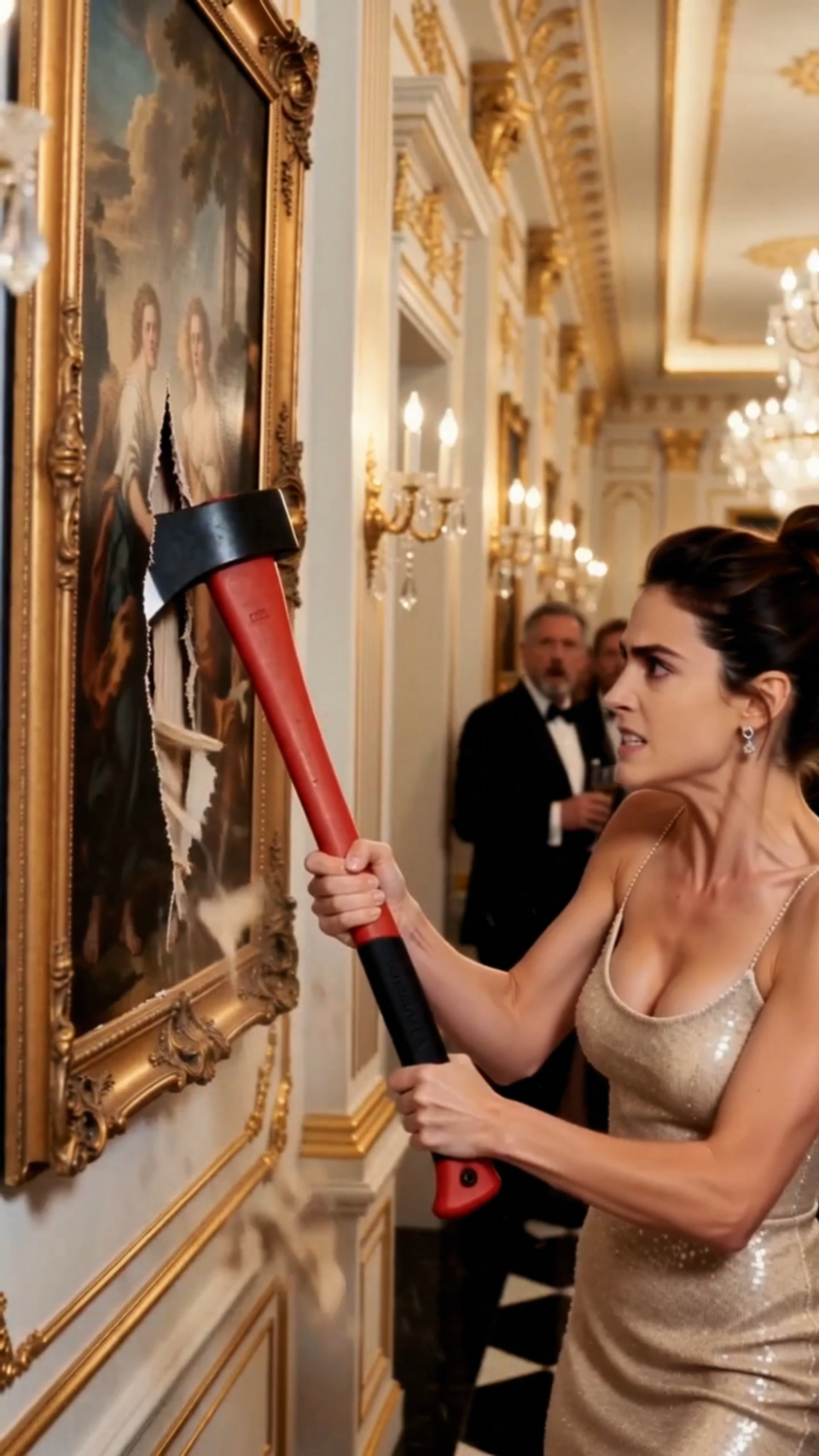
The question cut through the ballroom chatter just after I swung the fire ax for the second time.
A minute earlier, I had been smiling for photographs under the crystal chandeliers, my champagne-gold sequined gown catching the warm light. My hair was pinned into a careful updo. My silver earrings barely moved when I turned my head.
Then I heard it.
A child’s cry.
Thin. Muffled. Desperate.
At first I thought I had imagined it. The musicians were playing something low and elegant. Guests were laughing softly in the hall outside the banquet room. But then I heard it again, behind the huge oil portrait hanging in the west corridor.
So I grabbed the emergency ax from its glass case and brought it down hard.
The canvas split with a sound that made half the guests gasp.
I dropped the ax and tore at the hole with both hands. Dust fell into my face. Behind the ruined painting was a narrow black space between the walls.
“I heard someone crying behind this wall!” I shouted.
Then I saw them.
A pair of pale green eyes blinking in the dark.
A small hand reached toward me, trembling. The little girl couldn’t have been older than seven. Her light beige dress was smeared with dust. There was a scrape across the back of her hand.
“Please… help me.”
My heart lurched.
“Hold on. I’m getting you out right now.”
I reached for her just as people started screaming behind me. A wineglass shattered on the black-and-white marble floor, red wine spreading toward the narrow crimson runner.
Then Arthur Valliere came charging down the corridor.
At sixty-two, my fiance’s grandfather still carried himself like a king. His silver hair was neat. His black tailcoat looked perfect. Only his face gave him away.
He was furious.
“No! Step away from that wall!”
He grabbed my arm hard enough to hurt.
I tore free and faced him. My earrings swung wildly against my neck.
“There is a child trapped in there!”
I stepped closer, my voice shaking now with anger.
“Why is she so terrified of you?”
The little girl looked past me toward Arthur. Her dusty face crumpled.
“Elena,” she whispered, “don’t let him take me again.”
I had never seen her before in my life.
For one frozen second, nobody moved.
Then everything happened at once.
My fiance, Daniel, pushed through the crowd and caught my elbow. “Elena, step back. The wall could collapse.”
But I was already on my knees, pulling at broken wood and torn canvas with my bare hands. Two hotel staff members finally rushed in with tools. Someone called the police. Someone else called an ambulance.
Arthur didn’t move to help.
He stood rigid beneath the wall sconce, his gray eyes fixed on the opening as if the child inside were not frightened but dangerous.
That frightened me more than the cry had.
When the gap was wide enough, a paramedic squeezed into the space and brought the girl out. She weighed almost nothing. Dust clung to her tangled light brown curls and tear-streaked cheeks. The moment her feet touched the floor, she flinched from Arthur and ran straight into me.
I wrapped my arms around her.
“It’s all right,” I whispered, though it wasn’t.
She clutched the sequins of my dress in one shaking fist.
Daniel stared. “She knows you?”
“I don’t know her,” I said.
Arthur’s jaw tightened. “The child is confused.”
The girl buried her face against me and sobbed harder.
A police officer arrived and crouched to her height. “Sweetheart, can you tell me your name?”
She hesitated.
Then, very softly, she said, “Sophie.”
It was such an ordinary name. Yet the room reacted as if she had fired a gun.
Daniel turned to Arthur. “That’s impossible.”
I looked from one face to another. Several guests suddenly seemed desperate not to meet my eyes.
“Why impossible?” I asked.
Nobody answered.
The paramedics tried to guide Sophie toward a wheelchair, but she wouldn’t let go of me.
Then a woman in a server’s uniform stepped out from the crowd. She was in her late fifties, pale and visibly shaking.
“I know that child,” she said.
Arthur barked, “Be quiet, Marta.”
But the woman lifted her chin.
“No, sir. Not this time.” She pointed at the torn wall. “Three years ago, I saw her in this house nursery. And everyone was told never to speak her name.”
The police sealed off the corridor and moved the remaining guests back into the ballroom. The engagement celebration was over, though nobody needed to say it aloud.
Sophie sat wrapped in a blanket in a private sitting room off the main hall, still holding my hand. She had stopped crying, but every sudden sound made her jump.
Daniel stood by the fireplace, white-faced and silent.
Arthur demanded his attorney before answering questions.
Marta, the housekeeper, looked as if she had carried a stone in her chest for years and had finally set it down.
I sat in front of her. “Tell me everything.”
She glanced toward the door, then back at Sophie.
“She lived here for a few months,” Marta said quietly. “The nursery on the third floor was prepared for her. Toys, clothes, books. Mr. Valliere ordered all of it himself.”
Daniel stared. “For whose child?”
Marta’s eyes filled. “For your sister’s.”
The room seemed to tilt.
Daniel’s sister, Claire, had died four years earlier in what the family called a tragic car accident in Italy. I had seen her photographs all over the estate. Gentle smile. Green eyes.
Sophie’s eyes.
Daniel crossed the room in two steps. “Claire didn’t have a child.”
“She did,” Marta said. “She came back home pregnant after leaving that musician she loved. Mr. Valliere said the baby would ruin the family’s name. Claire refused to give her up.”
I squeezed Sophie’s hand as her fingers turned cold.
“What happened?” I asked.
Marta looked at Arthur’s empty chair, as if she still feared him.
“Claire tried to leave with the baby. The car went off the road before dawn.” Her mouth trembled. “Mr. Valliere said Claire died instantly and the infant died too.”
Daniel whispered, “He lied?”
Marta nodded. “The baby lived. Sophie lived.”
I looked at the child. She looked back at me with those ancient, frightened eyes.
Then she said something so quietly that I almost missed it.
“My mama showed me your picture.”
My breath caught. “My picture?”
Sophie nodded. “She said if anything bad happened, find Elena. Elena tells the truth.”
Daniel frowned. “How would Claire know you? You never met her.”
But I had.
Not as Claire Valliere.
I suddenly remembered a summer in Florence, six years ago, and a young woman sketching in a square, laughing as she asked me to take her photograph.
And in that photograph, around her neck, had been the same silver locket now hanging from Sophie’s blanket.
Inside it, Sophie said, was a picture of me.
The silver locket shook in my hand when Sophie passed it to me.
It was old, oval, and scratched near the clasp. I opened it carefully.
On one side was a tiny photo of Claire, younger and smiling into sunlight.
On the other side was me.
Not from a formal portrait. Not from social media. A candid picture taken on a bridge in Florence, my hair loose, laughing at something outside the frame.
Daniel looked over my shoulder. “How is that possible?”
I already knew.
“Because I took a train with her after my college graduation,” I said. “Her name wasn’t Claire then. She told me to call her Clara.”
The memory came back in pieces. Warm stone streets. Cheap coffee. A girl with green eyes who wanted one week of being nobody important. We talked for hours. About art. Family pressure. Fear. The life we might choose if we were brave enough.
On the last day she gave me a paper slip with a number and said, “If I ever disappear, remember I wanted my own life.”
I had lost the number in a move years ago.
Sophie’s voice was tiny. “Mama said you were the only person who listened.”
Marta reached into her apron pocket. “There is more.”
She laid a small key on the table.
“Claire gave me this the week before she died. She said if anything happened to her, I should open the locked nursery wardrobe. I was too afraid while Mr. Valliere controlled this house. Tonight, I’m not afraid anymore.”
We went upstairs together. The nursery had been closed for years. Dust covered the pale blue shelves. A rocking horse leaned in one corner.
Inside the wardrobe was a box of letters tied with ribbon, a passport for Claire and Sophie, and a recorded voice message on an old digital device.
We played it.
Claire’s voice filled the room, thin but steady.
“If you’re hearing this, my father has done exactly what I feared. He said he was protecting our family. He is protecting his pride. Sophie belongs with my brother, not in a wall, not in secret, and never in his hands again.”
Daniel sat down hard on the nursery floor.
Then footsteps thundered in the hall.
Arthur was coming.
And this time, he wasn’t alone. He had gone to the police first.
Arthur entered the nursery with two officers behind him, still dressed in his black tailcoat as if the evening could somehow be restored by force.
He pointed at Marta. “That woman stole private property. The child is unstable. My son is grieving. Miss Elena has caused public destruction and hysteria.”
I stood before Sophie.
“No,” I said. “You caused all of this.”
One officer asked to hear the recording. Arthur objected so sharply that even he seemed to hear the desperation in his own voice.
Daniel took the device from my hand and faced the officers himself.
“Play it.”
Claire’s message filled the room again. Every word landed harder the second time.
When it ended, silence held for a beat.
Then Daniel looked at his grandfather with a grief I had never seen in him before. “She begged you to let her go, didn’t she?”
Arthur’s face changed. Some of the arrogance drained away, leaving only an old man who had mistaken control for love for far too long.
“I was trying to save this family,” he said.
Marta answered him first. “You buried it alive.”
The officers took the letters, the passport, and the recording. One of them gently asked Arthur to come downstairs.
He did not resist.
Sophie pressed close to me, but this time she looked at Daniel too. He crouched carefully to her level.
“I’m your uncle,” he said, voice breaking. “If you’ll let me be.”
She studied him, then nodded once.
Three months later, the estate was quieter. The torn portrait was gone. The ruined section of wall had been opened fully, repaired, and turned into a window seat in the old nursery. Sophie liked to read there in the late afternoon sun.
Daniel and I did not marry.
Not because we stopped caring for each other, but because truth had changed the shape of everything. He needed time to become Sophie’s family. I needed time to become myself again.
We stayed in each other’s lives.
Some endings are not failures. They are honest beginnings.
One evening, Sophie climbed into the window seat with her locket around her neck and looked up at me.
“Mama was right,” she said. “You came.”
I kissed her dusty curls where the sunlight touched them.
And later that night, Daniel found one more letter hidden in Claire’s sketchbook.
It was addressed to me.
Để lại một bình luận