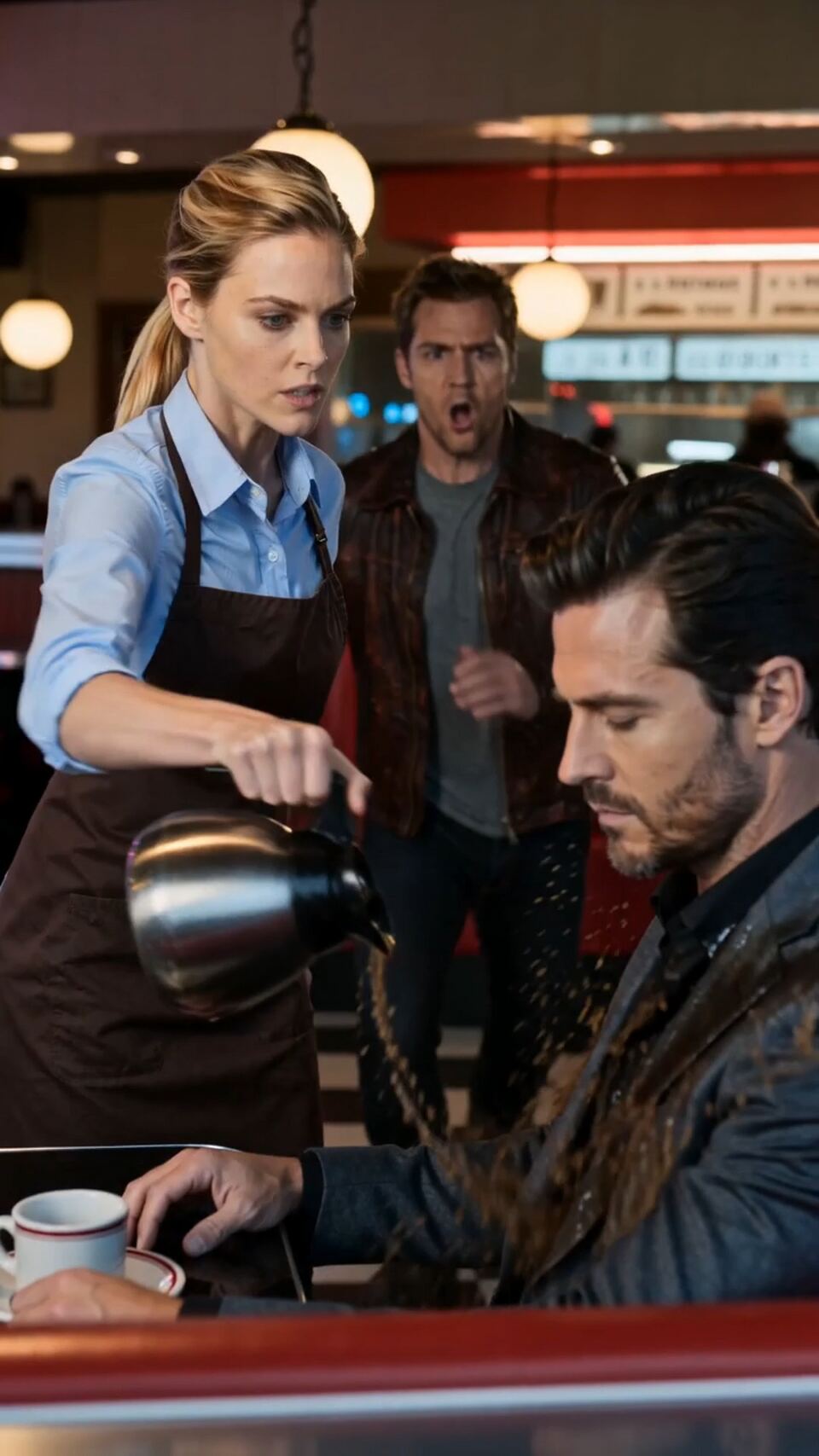
“What the hell are you doing?”
The whole diner heard it.
One second, I was standing beside the red-brown leather booth with a full coffee pot in my hand. The next, I was dumping hot coffee straight onto Dom Bozack’s expensive dark gray suit.
Coffee splashed across his black shirt and dripped to the black-and-white tile floor.
My hand shook so hard I nearly dropped the pot.
The man in the dark brown leather jacket lunged at me at once. He grabbed my wrist so hard I bit back a cry. His fingers dug into my skin.
“Let her go,” Dom said.
He didn’t raise his voice.
He didn’t need to.
The man loosened his grip, but he stayed close enough to block me. I could smell rain and cigarette smoke on his jacket. Dom sat very still in the booth, wet and furious in a way that looked colder than shouting.
He lifted his eyes to me.
“Why did you do that?”
My throat was dry. My heart was pounding so hard it hurt.
“That coffee was poisoned.”
For a moment, nobody moved.
The leather-jacket man gave a laugh too quick to be real. “She’s insane, Dom.”
I swallowed and forced myself to point.
“Ask him what’s in his pocket.”
Dom turned his head slowly.
The man touched his coat pocket without meaning to. Just once. But that was enough. His face had gone pale under the diner lights.
“Why are you shaking?” Dom asked.
“I’m not.”
Dom reached into his inside pocket, pulled out a thick stack of cash, and slapped it on the table beside the glass salt shaker, the pepper bottle, and the open menu.
“Keep the change.”
Then he stood. Tall. Broad. Dangerous.
He came so close I stopped breathing.
“That’s it?” I asked.
His gaze stayed on me for half a second too long. “That is all for tonight.”
He walked out into the rain.
Ten minutes later, I stood outside with my paper takeout bag in one hand, staring at a black car by the curb while a driver opened the back door.
“Am I being kidnapped?” I whispered.
The driver lowered his head. “Mr. Bozack wants to see you.”
When I looked into the dark back seat, I wasn’t expecting to find Dom.
I was expecting him even less with a gray-haired woman beside him, holding a photograph of my mother.
“Get in, Nora,” she said. “We need to talk about Elena.”
I froze with one foot in the rain.
Nobody had said my mother’s name in years. Not like that. Not with the voice of someone who had known her.
The woman in the back seat wore a camel coat and pearl earrings. She looked about seventy. Tired, elegant, and sick of secrets. Dom sat beside her, his soaked shirt hidden now under a dark overcoat. He watched me, unreadable.
“How do you know my mother?” I asked.
“Please,” the woman said. “Get in before someone sees.”
That was not comforting.
Still, I got in.
The driver shut the door. The city sounds vanished. Inside, it smelled like leather and rain.
The woman handed me the photograph. It was old and bent at the corners. My mother was maybe twenty, laughing beside a younger version of the woman in the car. They stood in front of a lake I didn’t recognize.
“My name is Vivian Bozack,” she said. “Elena worked for my family when she first came to this country.”
Worked for.
Not friend. Not sister.
Worked for.
I stared at her. “My mother cleaned houses.”
Vivian nodded. “Yes. Mine was one of them.”
That landed harder than I expected.
Dom spoke for the first time. “How did you know the coffee was poisoned?”
I looked at him. “Because your guy switched cups when he thought nobody was watching.”
“The man in the leather jacket?” Vivian asked sharply.
I nodded. “He poured from a little silver vial into the cup near the wall, then moved the cups when another customer asked me for napkins.”
Dom’s jaw tightened.
Vivian closed her eyes for one second. “Marek.”
So the leather-jacket man had a name.
“I want to go home,” I said.
“You can,” Dom said. “After one more question.”
I hated how calm he sounded.
“What question?”
Vivian leaned toward me. “Did your mother ever leave you a letter? A note? Anything she told you to keep hidden?”
I almost said no.
Then I remembered the salt-stained recipe box in my apartment kitchen. The one my mother made me promise never to throw away.
Before I could answer, Dom’s phone buzzed. He looked down, and for the first time, something changed in his face.
He turned the screen toward Vivian.
Marek was gone.
And the text sent from Marek’s phone said: She knows about the pocket. Find the girl first.
I should have gotten out of that car.
Instead, twenty minutes later I was unlocking my apartment door with Dom Bozack standing behind me and one of his men waiting in the hall.
Not Marek.
Marek had disappeared.
I lived above a laundromat in a building that always smelled faintly of soap and old pipes. I felt suddenly ashamed of the narrow kitchen, the scratched table, the faded curtains my mother had hemmed by hand.
Vivian saw everything.
So did Dom.
Neither said a word.
I went straight to the top shelf over the refrigerator and pulled down the old wooden recipe box. The corners were worn smooth. My mother had kept index cards inside it, stained with oil and cinnamon and time. Soup. Rice pudding. Roast chicken. Cheap meals stretched with love.
“She told me to keep this,” I said. “I thought it was because of the recipes.”
“It may still be,” Vivian said softly.
My hands trembled as I flipped through the cards.
Halfway down, I found an envelope taped beneath a card for apple cake.
My name was written on the front in my mother’s careful block letters.
For Nora. Only if someone comes asking about the lake.
I sat down because my knees gave out.
“Read it,” Dom said.
I shot him a look. “Don’t tell me what to do in my own kitchen.”
For the first time, I thought I saw the faintest sign of respect in his face.
I opened the letter.
Nora, if this is being read, then the past has found you. I did not steal from the Bozacks, though someone said I did. I took only what belonged to my child: proof of her father.
The room tilted.
Vivian pressed a hand to her mouth.
I kept reading.
If Dominic ever stands before you, tell him I left the Saint Christopher medal where his father proposed to me. He will know the place. He must know the truth about the fire.
I lowered the letter slowly.
Dom had gone still.
“Dominic?” I whispered.
He stared at me. “My full name is Dominic.”
Vivian looked between us like she was seeing two ghosts.
Then she said the impossible thing.
“Elena was carrying my husband’s child when she vanished.”
“That means you may not have saved a stranger tonight, Nora. You may have saved your brother.”
“No.”
That was all I could say at first.
No to the word brother.
No to my mother lying by silence.
No to the idea that the man in the expensive coat, the man who looked like danger in human form, could belong anywhere near my life.
Dom didn’t argue. He stood by the window while rain tapped the glass. Vivian sat at my kitchen table with my mother’s letter spread in front of her like evidence at a trial.
Finally, Dom spoke.
“My father had a hunting cabin by Lake Mercer.”
The photograph.
The lake.
“He took my mother there every fall,” Vivian said, her voice breaking. “Twenty-eight years ago, the cabin burned. Your mother disappeared the same week. My husband claimed she’d stolen cash and jewelry and run away.”
“And you believed him?” I asked.
She shut her eyes. “I wanted not to.”
Dom turned back toward us. “My father died six years ago. Before he died, he kept asking for a medal. A Saint Christopher medal.”
The one in the letter.
“He knew where it was,” I said.
“Or what it proved,” Dom answered.
We drove to Lake Mercer before dawn.
The cabin was gone, but the stone chimney still stood. Wet weeds pushed up through the old foundation. The lake behind it was gray as steel.
I followed the path from the letter’s clue, around the ruined chimney to a flat stone bench blackened long ago by smoke. Underneath, inside a crack, Dom found a small tin box wrapped in rotted cloth.
Inside was a scorched Saint Christopher medal.
And a folded document sealed in plastic.
Vivian opened it with shaking hands.
A birth certificate.
Mine.
Father: Anthony Bozack.
My mother had not stolen proof. She had hidden it.
Then tires crunched on gravel behind us.
Marek stepped out from a sedan, gun in hand, face wrecked with fear.
“I didn’t want to poison him,” he said. “Your father made me start years ago. Then Dom found out too much.”
Dom moved in front of me without thinking.
Marek’s hands shook. “The fire wasn’t an accident. Anthony set it to get rid of Elena.”
And then Marek pointed the gun not at Dom, but at Vivian.
Everything narrowed to breath, rain, and the dark circle of the gun.
Vivian stood beside the stone bench, one hand gripping my arm. Dom stayed in front of us, shoulders squared, wet wind flattening his coat against him.
“Marek,” he said, calm again. “Put it down.”
Marek laughed once, ragged and broken. “You think this ends with me? Your father kept records. Payments. Threats. He said if Elena ever came back, the old lady would protect the family name.”
Vivian flinched as if struck.
“I was wrong,” she whispered.
I looked at her. Not because she had caused all of this alone. But because she had lived beside it. She had chosen comfort over truth until truth came to her door in a diner uniform.
Marek waved the gun wildly. “I just followed orders.”
“No,” I said.
My voice surprised all of us.
“You poisoned a man. You grabbed me. You ran because you knew exactly what you did.”
His eyes snapped to me.
That was enough.
Dom moved fast. So fast I barely saw it. He knocked Marek’s wrist aside as the gun fired into the wet ground. The sound rolled across the lake. Dom drove him down hard. By the time the driver and the second guard reached us from the car, it was over.
Later, after the police took Marek away, we stood by the old chimney and watched morning come up over the water.
Vivian touched the medal in my palm. “Your mother deserved better from all of us.”
I believed she meant it.
Dom looked at me. For once, there was no threat in his face. Only weariness. And something careful.
“We can prove what my father did,” he said. “The records, the letter, Marek’s statement. Your mother won’t stay buried under his lie.”
I nodded, but tears still came.
Months later, I left the diner by choice, not fear. Vivian helped reopen the Lake Mercer cabin land as a retreat house for single mothers starting over. I kept the recipe box on my new kitchen counter.
Dom and I were still learning what brother and sister could mean when it began this late.
It meant awkward lunches.
Hard questions.
Small acts of loyalty.
One Sunday he came by with a bakery box and set it next to the salt shaker on my table.
“Apple cake?” I asked.
He gave a short nod. “From your mother’s recipe card. Mine came out terrible.”
I laughed for the first time in front of him without effort.
Then he pulled a second envelope from his coat.
“What now?” I asked.
He looked almost uneasy.
“We found one more letter in my father’s records,” he said. “It’s addressed to you. But the handwriting isn’t his.”
I turned it over.
It was my mother’s.
And this one began, My dearest Nora, if Dominic has found you, then I have one more truth to tell.
Để lại một bình luận