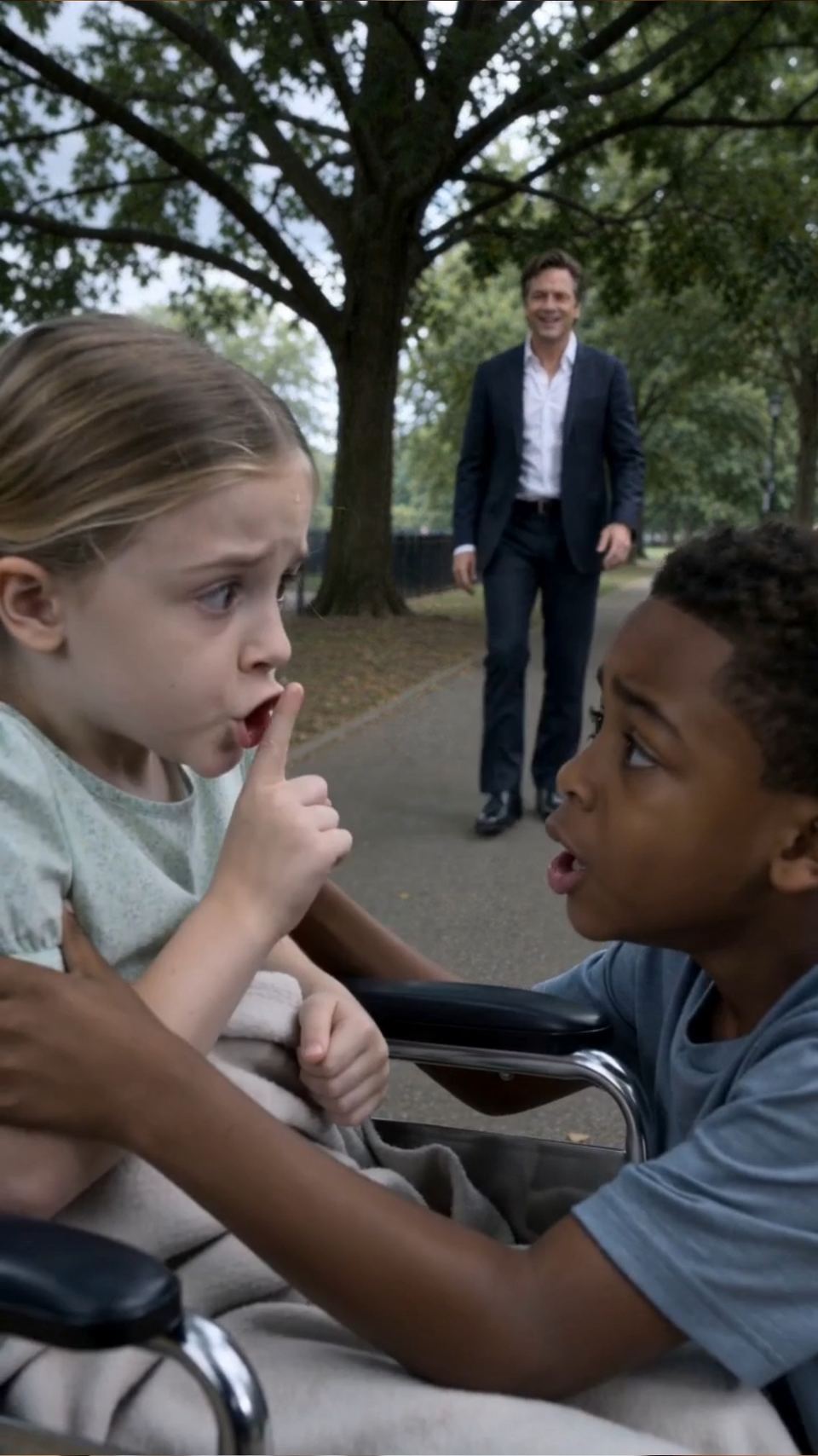
“Come on, one more try! I’m right here with you.”
The boy’s voice was eager and soft, almost swallowed by the heavy afternoon air.
Daniel Mercer had been smiling a second earlier.
He had left work early for once. No calls, no meetings, no excuses. He wanted to surprise his daughter at the community park. Lily loved the little sand corner under the elm trees, even if she could only watch other children play from her wheelchair.
Or so he believed.
Clouds covered the sun as he stepped onto the shaded path in his dark suit. Then he saw a boy in a yellow T-shirt crouched in front of Lily’s wheelchair, his hands wrapped carefully around her arms.
Lily wore her pale green dress. The thick blanket still covered her legs.
Daniel slowed.
The boy braced himself. Lily pushed down on the wheelchair arms, face tight with effort.
Then she lifted one finger to her lips.
“Shh. Don’t tell everyone,” she whispered. “Mommy told me I have to pretend I can’t walk.”
Daniel stopped so suddenly his shoe scraped gravel.
He stayed behind the tree without meaning to. His body had gone cold.
The boy blinked. “But why?”
Lily only shook her head. She was breathing hard. Then, biting her lip, she let the boy support her.
One foot.
Then the other.
Her legs trembled, but she stood.
The blanket slid to the sand.
“Look, you are standing!” the boy cried.
Daniel’s hand caught the tree trunk to keep himself upright.
“Pretend… she can’t walk…?”
His whisper sounded like it belonged to a stranger.
Lily turned toward the sound. Her eyes widened. The joy on her face vanished so fast it hurt to see.
“Daddy?”
Before Daniel could move, another voice came from the path behind him.
“Daniel,” his wife said sharply. “What exactly are you doing here?”
Catherine Mercer stood in a cream raincoat, one hand still on the stroller of Lily’s little brother, Owen.
Her face was calm.
Too calm.
Daniel looked from his wife to his daughter, still half-standing, half-falling against the wheelchair. The boy in the yellow shirt backed away at once, scared by the adults’ silence.
“Lily,” Daniel said, fighting to keep his voice steady, “come here.”
Catherine moved first. She rushed to Lily, pulled the blanket up over her legs, and settled her hard into the wheelchair.
“She overdid it,” Catherine said quickly. “Dr. Feldman said there might be reflex movement.”
Lily stared at her hands.
The answer was too smooth. Too ready.
Daniel knelt in front of his daughter. “Sweetheart, did Mommy tell you to say you couldn’t walk?”
Catherine’s voice snapped like a wire. “Not in front of strangers.”
The little boy in yellow spoke up anyway. “She stood up before. At recess too. She just said it’s a secret.”
Catherine turned to him. “Where are your parents?”
He pointed weakly toward the basketball court and fled.
Daniel rose slowly. “She stood up before?”
Catherine lowered her voice. “We are going home.”
“No,” he said. “We’re going to Dr. Feldman. Right now.”
At the clinic, Lily stayed silent. Catherine did most of the talking. She reminded the neurologist about old scans, physical therapy, the episodes of weakness after fever, the fatigue. Daniel had trusted every word for three years.
Dr. Feldman examined Lily. He asked her to push, bend, lift.
Then he stepped back, troubled.
“When did she begin bearing weight consistently?” he asked.
Daniel answered first. “Today. In the park.”
Catherine’s jaw tightened.
Dr. Feldman frowned. “That doesn’t fit the chart. Her last report said she had no meaningful improvement.”
Daniel looked at him. “You wrote that report.”
Dr. Feldman hesitated.
Then he opened Lily’s file again and said, “No. That report wasn’t written by me.”
By evening, Daniel felt as if every hour of the last three years had been placed under a harsh white light.
He sat in a small consultation room while Lily colored quietly in the corner. She had drawn a tree, a wheelchair, and a bright yellow shirt.
Catherine asked for a lawyer.
Daniel almost laughed at the absurdity of the request. “We’re in a pediatric clinic, Catherine, not a courtroom.”
She folded her arms and said nothing.
Dr. Feldman returned with the office manager and a printed stack of records. There it was in black and white: progress notes from months Daniel remembered clearly. Appointments he had paid for. Recommendations to continue wheelchair use. Warnings against unsupervised standing.
But some electronic signatures were false.
Dr. Feldman’s nurse, a tired woman named Elaine with silver hair and reading glasses on a chain, pointed to the screen. “These were uploaded from a home portal account, not from our office terminal.”
Daniel turned to Catherine.
She looked pale now, but still defiant. “I did what I had to do.”
“For what?” he asked.
Lily’s crayon stopped moving.
Catherine glanced at their daughter, and for the first time her face cracked. Not with guilt. With fear.
“Because if she started walking again,” she whispered, “you would’ve taken her.”
Daniel stared at her. “What?”
Elaine gently led Lily out for juice and cookies, closing the door behind them.
Catherine finally looked at Daniel directly. “You were gone all the time after the diagnosis. Work, flights, conferences, dinners. Every time I said I was drowning, you sent money. If Lily got better, you would’ve gone back to your old life and left us with a miracle you barely witnessed.”
Daniel felt the blow because some part of it was true.
But not this.
Not this.
“You made our daughter believe her own body was a secret,” he said.
Catherine started crying then, quiet and ugly and real.
“I never thought it would go this far.”
Daniel pressed both hands against the table.
Then Elaine came back holding a small envelope.
“This was in Lily’s backpack,” she said. “It looks like she meant to give it to someone.”
On the front, in a child’s uneven handwriting, were three words:
For Daddy Only.
Daniel opened the envelope with shaking fingers.
Inside was a folded sheet of paper covered in careful block letters. Some words were backward. Some were misspelled.
But the meaning was clear.
Daddy,
I wanted to show you I can do it. Mommy said not yet because if you know I am better everything will change and she will be alone again. I don’t want Mommy alone. I don’t want you gone. I practiced with Malik because he is nice and does not laugh when I shake. Please don’t be mad. Love, Lily
Daniel read it twice.
Then a third time.
The room blurred.
The thick blanket from the wheelchair lay across the other chair like evidence. He could not stop looking at it. Three years of fear. Three years of pity. Three years of arranging life around loss. And under it all, a small girl trying to keep two adults from breaking apart.
Catherine sat with her face in her hands.
“I was scared,” she said. “After Owen was born, after Lily got sick, after you started sleeping in hotels more than at home… I felt myself disappearing. Everyone asked about Lily. Nobody asked if I was all right. When she first stood between the sofa and the coffee table, I panicked. I thought if the crisis ended, I would have to admit what our marriage had become.”
Daniel wanted to rage at her.
Part of him did.
But another part saw the exhausted woman who had been living inside a locked room of her own making.
“Fear explains it,” he said. “It doesn’t excuse it.”
She nodded through tears.
Dr. Feldman recommended a child psychologist, a full new evaluation, and immediate reporting to social services. Not to destroy the family, he said, but to protect Lily.
Daniel signed the papers.
Catherine didn’t protest.
Then Lily appeared in the doorway with a juice box in one hand. “Daddy,” she asked softly, “are we still a family?”
Daniel went to her at once and knelt.
“We tell the truth now. That’s how we stay one.”
Lily reached for him.
Behind her, a woman from Child Protective Services stepped into the hall and said, “Mr. Mercer, I need to ask your daughter a few questions. And I need to know whether she has an aunt named Sarah Bennett.”
Daniel froze.
Sarah was his sister.
They had not spoken in eleven years.
Sarah Bennett arrived the next morning wearing jeans, a navy cardigan, and the guarded expression Daniel remembered from their father’s funeral.
She looked first at Lily.
Then at the wheelchair.
Then at Daniel.
“I came because the caseworker called,” she said. “And because Lily wrote to me last month.”
Daniel turned. “Lily wrote to you?”
Lily nodded from the sofa. Without the thick blanket, her legs looked small but strong, restless under her pale green dress. “Grandma gave me your address.”
Sarah sat beside her and took a folded card from her purse. It was another note in Lily’s uneven print. A child asking why families stopped speaking. A child asking if a person could have two homes and still belong.
Daniel closed his eyes.
He and Sarah had not spoken since he sold their mother’s house too quickly after her death. He had called it practical. Sarah had called it betrayal. Maybe they were both right.
Now here they were, brought back by a little girl who had spent too long carrying adult fear.
The weeks that followed were messy.
Catherine moved into her sister’s apartment while the investigation continued. She was required to attend psychiatric treatment and family counseling if she wanted shared custody. Daniel agreed, not because he forgave easily, but because Lily needed a mother who got help more than she needed a father who won.
Lily began intensive therapy honestly this time.
Malik visited with comic books and impossible optimism.
And one cold Friday in November, at the same park, Lily stood between Daniel and Sarah without anyone hiding behind a tree.
Her legs trembled.
Her chin lifted.
She took three steps on her own.
Daniel felt Sarah’s hand grip his arm, and for once he didn’t pull away.
Lily laughed, bright and breathless.
Then she looked up at both of them.
“Did you see me?”
Daniel smiled through tears.
“Every step.”
That night, after Lily fell asleep, Sarah stayed at the kitchen table with a cup of tea. The silence between them felt different now. Not healed. But open.
Then Daniel noticed an old photo Sarah had left beside Lily’s drawing from the clinic.
In the picture, their mother stood in this same park, one hand on each of them, as if she had always known they would need help finding the way back.
Để lại một bình luận