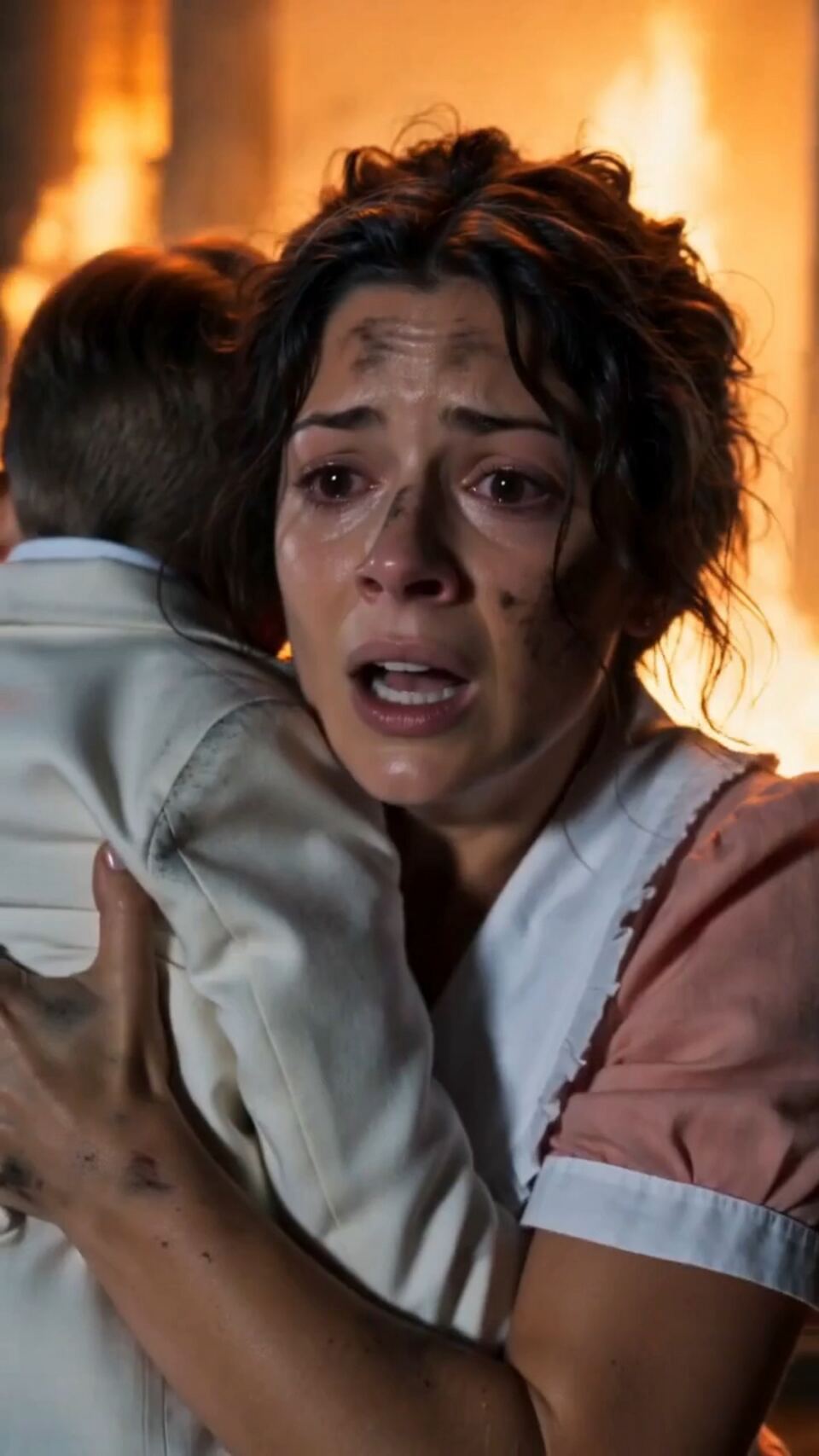
Flames poured from the mansion’s upper windows.
Clara Bennett struggled to break free from the two people holding her on the lawn.
“Henry is still inside!”
Eleanor Whitmore tightened her grip on Clara’s arm. Her dark green evening gown was streaked with ash.
The family’s elderly butler, Arthur Bell, held Clara’s other arm.
“Don’t go back in there!”
Part of the roof collapsed.
Clara stopped fighting for one second.
Then she kicked off her shoes, tore herself free, and ran toward the mansion.
Arthur shouted after her, but he did not follow.
Smoke covered the main hallway. Burning wood fell from the ceiling, and the heat made it almost impossible to breathe.
Clara wrapped part of her uniform over her mouth.
“Henry!”
She heard coughing from the east corridor.
Henry sat alone in the middle of the hallway. The seven-year-old boy wore a white suit and a small bow tie. Soot covered his face, and both hands gripped the sides of his wheelchair.
Clara rushed toward him.
The wheelchair would not move.
Someone had locked the wheels and broken one of the release handles.
Clara lifted Henry from the chair.
“I got you!”
He wrapped his arms around her neck.
Clara carried him through the smoke. Behind them, burning beams crashed across the hallway.
They reached the front entrance seconds before part of the balcony fell.
Clara threw herself onto the lawn, protecting Henry with her body.
Eleanor stared at them.
For one brief moment, relief crossed her face.
Then Clara saw something else.
Fear.
Not fear for Henry.
Fear that he had survived.
Henry slowly raised his head from Clara’s shoulder. He looked at Eleanor and Arthur.
“They left me.”
Eleanor stepped forward.
“Henry is confused. He inhaled too much smoke.”
Henry shook his head.
“Arthur locked my wheelchair.”
Clara looked at the old butler.
Henry had called him Arthur in public for years.
But that night, he used another name.
“Dad told me the fire would make everything disappear.”
The firefighters turned toward Arthur.
Everyone outside the family believed Eleanor’s late husband had been Henry’s father.
Only Clara knew the truth.
Arthur was Henry’s biological father.
Henry opened one soot-covered hand.
Inside it was a small brass key.
“Mom wanted this,” he whispered. “She said I had to die before she could have it.”
The fire had not trapped Henry by accident. His own parents had expected it to kill him.
Henry was taken to the hospital.
Doctors treated him for smoke inhalation and several minor burns. Clara remained beside him until he fell asleep.
Eleanor arrived with a family attorney.
She demanded that Clara be removed.
“That woman disobeyed a direct order and carried my son through a collapsing building.”
“Your son was locked inside,” Clara replied.
Eleanor’s expression hardened.
“The fire caused the lock to fail.”
The fire investigator entered the room.
“The wheelchair lock was damaged before the fire reached that corridor. The bedroom door was also locked from the outside.”
Arthur claimed he had searched for Henry during the evacuation.
Clara stared at him.
“You were already on the lawn when I came out of the servants’ quarters.”
Arthur avoided her eyes.
Henry woke and asked for a small device attached beneath his wheelchair seat.
Clara recognized it.
It was a voice recorder she gave him several months earlier. Henry used it to record school assignments when writing became painful.
A firefighter had recovered it from the hallway.
The plastic casing had melted along one side, but the memory card still worked.
The recording began during the family dinner.
Eleanor’s voice could be heard in the library.
“The audit begins Monday. If they examine Henry’s trust, they will find everything.”
Arthur answered.
“Then we leave tonight.”
“We cannot leave without the shares.”
A chair moved.
Then Henry’s frightened voice came through the recording.
“What shares?”
There was a long silence.
Eleanor ordered Arthur to take Henry upstairs.
The next part contained the sound of the wheelchair moving down the hallway.
Arthur spoke quietly.
“I’m sorry, son.”
Then the wheels locked.
Henry called after him.
Arthur did not return.
Minutes later, an alarm began ringing.
The final conversation came from the other side of the closed door.
Clara heard Eleanor clearly.
“Leave him. When Henry dies, the trust returns to me.”
The hospital room became silent.
Eleanor moved toward the recorder.
The investigator stopped her.
The brass key in Henry’s hand belonged to a private document box created by Eleanor’s late husband, Robert Whitmore.
Robert had died two years earlier.
Before his death, he told Henry never to give the key to anyone except Margaret Sloan, the family’s former attorney.
Eleanor had spent two years searching for it.
That evening, Margaret was already traveling to the hospital.
Whatever Robert had hidden inside the box was valuable enough for Eleanor and Arthur to set fire to their own home.
Margaret Sloan arrived shortly after midnight.
She was sixty-eight and had served as Robert’s attorney for more than thirty years. Eleanor dismissed her after Robert’s death and claimed she was too old to manage the family estate.
Margaret ignored Eleanor and went directly to Henry.
“Your grandfather told me you might need my help one day.”
Henry handed her the brass key.
Robert was not Henry’s biological father, but he had raised him from birth. He discovered Eleanor’s relationship with Arthur shortly before Henry turned five.
Instead of rejecting the child, Robert changed his will to protect him.
The brass key opened a document box inside a private bank vault.
Margaret, the police, and an independent trustee examined its contents.
The box held Robert’s original will, financial records, and a letter addressed to Henry.
The will gave Henry fifty-one percent of the Whitmore Hotel Group when he turned eighteen. Until then, an independent board would manage his shares and pay for his medical care.
If Henry died before turning eighteen, control of the shares would return to Eleanor.
The financial records revealed that Eleanor and Arthur had stolen more than eight million dollars from Henry’s medical trust. They also took money from the retirement accounts of hotel employees.
An independent audit was scheduled to begin in three days.
Eleanor needed Henry dead before the missing money was discovered.
The fire would destroy the mansion’s financial office, eliminate the child who controlled the shares, and create an insurance payment large enough to cover part of the theft.
Investigators found that fuel had been poured through the east corridor.
The mansion’s security system had been disabled using Arthur’s private code.
Clara’s staff card had been used to purchase the fuel.
“She set the fire,” Eleanor declared. “She wanted to kidnap Henry after rescuing him.”
Clara was questioned for hours.
Then Margaret found another document in Robert’s box.
Robert had hired a private investigator shortly before his death. The investigator photographed Eleanor and Arthur transferring money into foreign accounts.
One photograph showed Arthur purchasing the same fuel used in the fire.
Another showed Eleanor meeting with the insurance assessor two weeks earlier.
Arthur began to panic.
He offered to testify against Eleanor if the police protected him.
Eleanor looked at him with disgust.
“You were the one who locked your son in that corridor.”
Arthur lowered his head.
“And you were the one who told me not to unlock it.”
Before either could be arrested, a nurse entered Henry’s room.
His bed was empty.
The wheelchair beside it had also disappeared.
A service elevator was moving toward the underground parking area.
Someone had taken Henry before he could give the police his full statement.
Clara ran toward the stairwell.
The police followed.
A hospital security camera showed Arthur’s younger brother, Daniel Bell, pushing Henry’s wheelchair into the service elevator.
Daniel managed several companies used to hide the stolen trust money. He knew Henry’s testimony could connect him to Eleanor and Arthur.
The elevator opened in the parking garage.
Daniel pushed the wheelchair toward a waiting car.
Henry grabbed the wheel and turned it sharply. The chair struck a concrete pillar.
Daniel tried to lift him.
Henry screamed.
Clara heard him from the stairwell.
She reached the parking garage before the car door closed.
“Put him down.”
Daniel laughed.
“You’re a maid. This is none of your business.”
Clara moved between him and Henry.
“He is my business.”
Police entered from the opposite side of the garage.
Daniel released the wheelchair and attempted to run. He was arrested before reaching the exit.
Henry clung to Clara.
“I knew you would come.”
Clara knelt beside him.
“I will always come when you call.”
Eleanor, Arthur, and Daniel were charged with attempted murder, kidnapping, fraud, theft, and conspiracy. Arthur confessed to locking Henry in the hallway and disabling the fire alarm near his room.
He claimed he had followed Eleanor’s instructions because she promised they would leave together after collecting the insurance money.
Eleanor showed no remorse.
During questioning, she blamed Henry.
“Robert left everything to a child who cannot even walk.”
Margaret looked directly at her.
“Henry’s legs were never the reason you underestimated him.”
The stolen money was frozen before it could be transferred. Margaret restored the employee retirement accounts and placed Henry’s inheritance under independent protection.
Social services asked Henry where he wanted to stay after leaving the hospital.
He did not ask for the mansion.
He asked for Clara.
However, Clara could not become his guardian immediately. She had to complete interviews, background checks, and training.
Henry entered a temporary care home while the process continued.
Clara visited every day.
Sometimes he refused to speak.
Sometimes he asked whether she had changed her mind.
Her answer never changed.
“No.”
Three months later, a judge approved Clara as Henry’s temporary guardian.
She signed the papers with shaking hands.
Henry read every page before signing his name beneath hers.
For the first time, Henry was going home with someone who had chosen him before choosing the money.
Eleanor and Arthur were convicted the following year.
Eleanor received a long prison sentence. Arthur’s cooperation reduced his sentence, but Henry refused all contact with him.
Daniel Bell was also convicted for fraud and attempted kidnapping.
Clara left her job as a maid.
With Margaret’s help, she trained as a support worker for children with physical disabilities and trauma. Henry’s trust paid only his necessary expenses. Clara insisted on supporting their household with her own income.
They moved into a small house with a bedroom on the ground floor.
Henry chose blue walls, low shelves, and a desk beside the window.
He also asked for two doors leading out of the house.
Clara understood why.
For months, the smell of smoke caused him to panic. He slept with the hallway light on and asked Clara to check the smoke alarms every night.
She never told him he was being unreasonable.
On the first anniversary of the fire, Margaret came for dinner.
She brought Robert’s final letter.
Henry had refused to read it before.
This time, he opened it.
Robert wrote that learning the truth about Henry’s birth had hurt him, but it never changed the way he felt about the child.
You were my son because I loved you, not because your name appeared beside mine on a certificate.
Henry folded the letter.
“Do I have to forgive Eleanor and Arthur?”
“No,” Margaret replied.
“Do I have to call Robert my father?”
“You can call him whatever feels true.”
Henry thought about it.
“He was my dad.”
Clara placed a small birthday cake on the table. His birthday had passed during the investigation, and he had refused a celebration.
Now eight candles waited in front of him.
Henry stared at the flames.
Clara reached for them.
“We don’t have to light them.”
Henry stopped her.
“Leave them.”
Margaret closed the curtains while Clara opened the back door.
Henry checked that the exit was clear.
Then he moved his wheelchair closer to the table.
“Ready?” Clara asked.
Henry took her hand.
He leaned forward and blew out all eight candles.
Để lại một bình luận