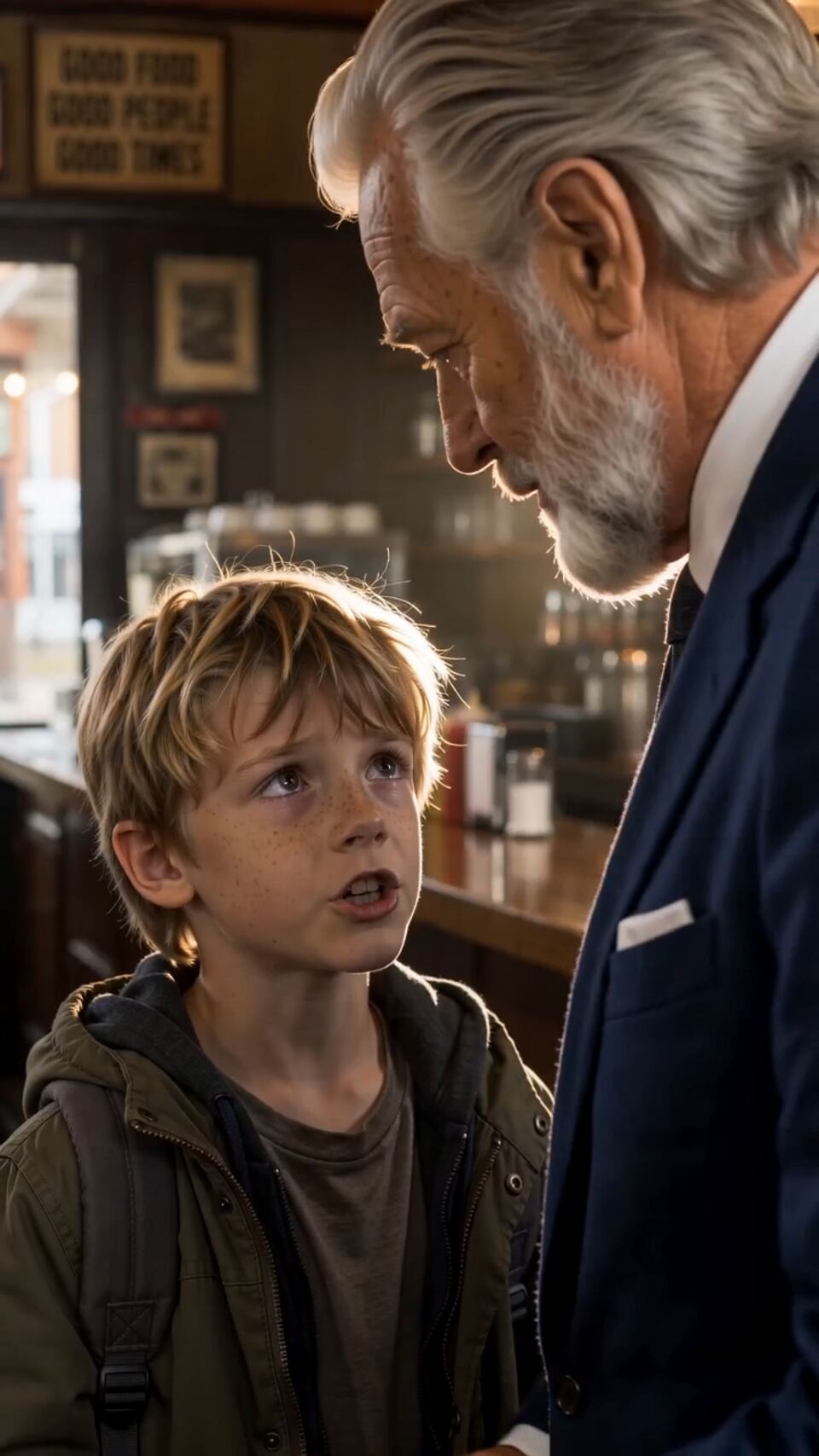
“Excuse me, Is this enough for a hot meal? Or anything…”
Eli’s small hand shook as he pushed three coins across the diner counter.
The waitress barely looked at him.
“Not even close. If you ain’t got money, just leave.”
She slid the coins back with two sharp fingers. Eli flinched, like the sound hurt him more than the words.
Then the bell over the door rang again.
An older man stepped inside. He paused at the sight of the boy.
He walked straight to the counter and set down a ring of keys and the watch with a solid clink.
“M-Mr. Harrison!” the waitress stammered. “I was just…”
“Get the boy whatever he wants. On my tab.”
The whole diner seemed to tighten around those words.
The man turned to Eli, and his face softened in a way that made the boy stare.
“Go on,” he said. “Take a seat, son.”
Eli did not move. Not until he looked up and asked the question that changed the room.
“Excuse me, sir… Do you know my mom, Sarah?”
The man’s hand froze on the counter.
“Sarah?” he whispered. “What is her last name?”
Eli swallowed hard.
“Harrison. Just like yours.”
The man’s face went pale before he even answered. Eli saw it. The waitress saw it too, and for once she said nothing.
The diner owner, Robert Harrison, guided Eli to a booth near the window. He ordered soup, grilled cheese, and a glass of milk. Eli ate carefully, like he was afraid the food might disappear if he moved too fast.
“Where is your mother now?” Robert asked.
Eli looked down at the table. “At the clinic. She was coughing blood. They said she had to wait.”
Robert’s jaw tightened. “How long has she been sick?”
“I don’t know. She tells me not to worry.”
That sentence hit Robert harder than any accusation could have.
He asked for the clinic’s name, and when Eli gave it, his eyes shut for a second. Not in confusion. In recognition.
The waitress hovered nearby, suddenly unsure of herself. “Mr. Harrison, do you know this woman?”
Robert did not answer her. He only asked Eli for Sarah’s full date of birth. Eli gave it after a pause, reciting it like a birthday song he had memorized in secret.
Robert stood so fast his chair scraped the floor.
“Who brought you here?” he asked.
“My mom left me with Mrs. Vega at the laundromat. She said she’d be back after the test.”
Robert reached for his keys, then stopped. His fingers tightened around them.
At the counter sat the receipt printer’s fresh strip of paper. On top of it was a folded note, pushed there by the waitress when she thought no one was looking.
Robert opened it.
Inside was a clinic call-back number and one handwritten line:
Do not let Sarah come here. She already asked about you once.
Robert stared at the note, then at Eli.
“Who wrote this?” he said.
Eli shook his head. “I don’t know.”
But the handwriting on the note looked painfully familiar.
Robert drove Eli to the clinic himself. The boy sat silent in the passenger seat, holding the paper cup of milk with both hands.
The clinic receptionist recognized Robert immediately. That should have comforted him. Instead, it made the room feel smaller.
Sarah was not in the waiting area.
A nurse finally led them to a back office and lowered her voice. “She’s being examined right now. She came in alone. She said she didn’t want her son scared.”
Robert went still. “Her son?”
The nurse nodded. “Eli, right?”
That was when Robert understood this was not a chance meeting. Sarah had known his name. She had known where to find him. She had sent the boy into his diner because she had run out of options.
When Sarah was brought out, she looked thinner than memory, but her eyes were the same. Sharp. Brave. Tired.
She saw Robert and closed her eyes for one brief second.
“I didn’t want this,” she said.
Robert could barely speak. “You have my name. He has my face. And you were going to die before telling me?”
Sarah flinched, but she did not look away. “I was going to tell you when I had proof.”
“Proof of what?”
She reached into her coat and pulled out an old photograph. It showed Robert years ago, standing outside the diner with a younger Sarah beside him. On the back was a date from more than seven years earlier.
“I came back for you,” she said. “You never showed.”
Robert stared at the photo. Memory returned in pieces. A storm. A train delay. A letter he never got because his sister said Sarah had moved on.
His sister.
The same one who had mailed the clinic note.
Robert turned slowly. “You knew she was pregnant.”
Sarah’s mouth trembled. “Your sister told me you were married.”
The lie landed between them like broken glass.
Eli, frightened by their silence, stepped forward and took Robert’s sleeve.
“Please don’t send us away,” he whispered.
Robert looked at the boy, then at Sarah, and for the first time in years he felt shame more than shock.
But the nurse was already returning with a chart in her hand.
“Mr. Harrison,” she said carefully, “we need you to see this. The test results are not what Sarah expected.”
The chart was thin, but it changed everything.
Sarah did not have the illness they feared. She had severe anemia, a lung infection, and exhaustion from months of working nights and skipping meals. Dangerous, yes. But treatable.
The worst part was the handwritten note at the bottom of the file.
Recommended follow-up for child: possible genetic screening.
Robert looked up sharply. “Why would they test Eli?”
Sarah pressed both hands to her face. “Because of my brother.”
That was the part she had not said yet.
Her younger brother had died at thirty-eight from a heart condition no one in the family had understood until too late. Sarah had feared Eli might carry the same risk. She had been trying to get him checked without worrying him.
Robert sat down slowly.
Everything he had imagined was wrong. She had not come looking for money or drama. She had been trying to protect the child.
“I thought you left,” he said.
“I thought you were married,” she answered. “By the time I learned the truth, I was already raising a son alone.”
The sister who had lied was not there now, but her note sat on the table like a third voice in the room.
Robert took it out and read it again.
Do not let Sarah come here. She already asked about you once.
Sarah laughed once, bitter and sad. “She said you wanted no part of us.”
Robert stood. His hands were shaking now. “She kept us apart.”
“Yes,” Sarah said. “But I also stayed silent. I was angry. I was proud. Then life kept moving.”
Eli had been listening with the serious stillness children get when adults finally stop hiding.
“So you’re my grandpa’s brother?” he asked Robert.
Robert gave a broken smile. “Something like that.”
“No,” Sarah said softly, looking at Robert. “If you want to be in his life, you need to decide that honestly. Not because of guilt.”
That was the real test.
Not the illness. Not the lie.
Could Robert accept a child he had never known, without using shame or pity as his reason?
He looked at Eli, then at Sarah, then at the clinic window where afternoon light was fading.
“I want to know my grandson,” he said.
Sarah’s head came up. “What did you say?”
Robert answered before fear could stop him. “Eli is my grandson. And if you’ll let me, I want to be his family.”
At that moment, the nurse returned with another envelope. It had been dropped off at the front desk an hour earlier.
On the front, in Robert’s sister’s handwriting, were four words:
Ask about Eli’s father.
Robert opened the envelope with the care of a man handling old wounds.
Inside was a letter from his sister, Margaret, written before her stroke last winter. Her hand shook across the page, but the words were clear.
I lied because I was afraid. Sarah came to me after your accident and asked if you were married. I told her yes. I thought I was protecting you from pain. Then I found out I was protecting my own pride.
The letter continued.
Eli’s father was not a stranger. It was Daniel, Robert’s late brother, who had once loved Sarah too. Margaret had known all along. Daniel had died before the truth could be sorted out. Sarah had chosen silence rather than drag the family into grief and blame.
Robert lowered the page and closed his eyes.
Sarah had not stolen anything from him. She had survived what everyone else had hidden.
He looked at Eli. “You have two families in this story,” he said. “And I have been missing one of them for seven years.”
Eli’s mouth curved into a careful smile. “Can I still have soup?”
That sound, so ordinary and alive, nearly undid him.
In the weeks that followed, Robert paid for Sarah’s treatment without making it a debt. He visited the clinic every afternoon. He brought books for Eli, then a football, then a small toolbox because the boy liked fixing broken things.
Sarah slowly regained her strength.
Robert and Sarah did not become the people they had been. Too much had passed between them for that. But they found something gentler. Honest visits. Shared meals. Real apologies.
Margaret never had the chance to explain herself in person. She died two months later. At her funeral, Robert placed her folded letter in her casket and forgave her out loud, even though the words hurt.
One spring evening, Eli sat beside him on the diner bench and asked, “Are you going to stay this time?”
Robert looked through the window at Sarah, laughing with the waitress who had once pushed away his coins.
“Yes,” he said. “This time, I am staying.”
Then Eli reached into his pocket and pulled out three worn coins.
He placed them on the table between them.
“I kept them,” he said. “To remember the day everything started.”
Robert covered the boy’s hand with his own.
Outside, the bell above the diner door rang again, and this time no one was being turned away.
Để lại một bình luận