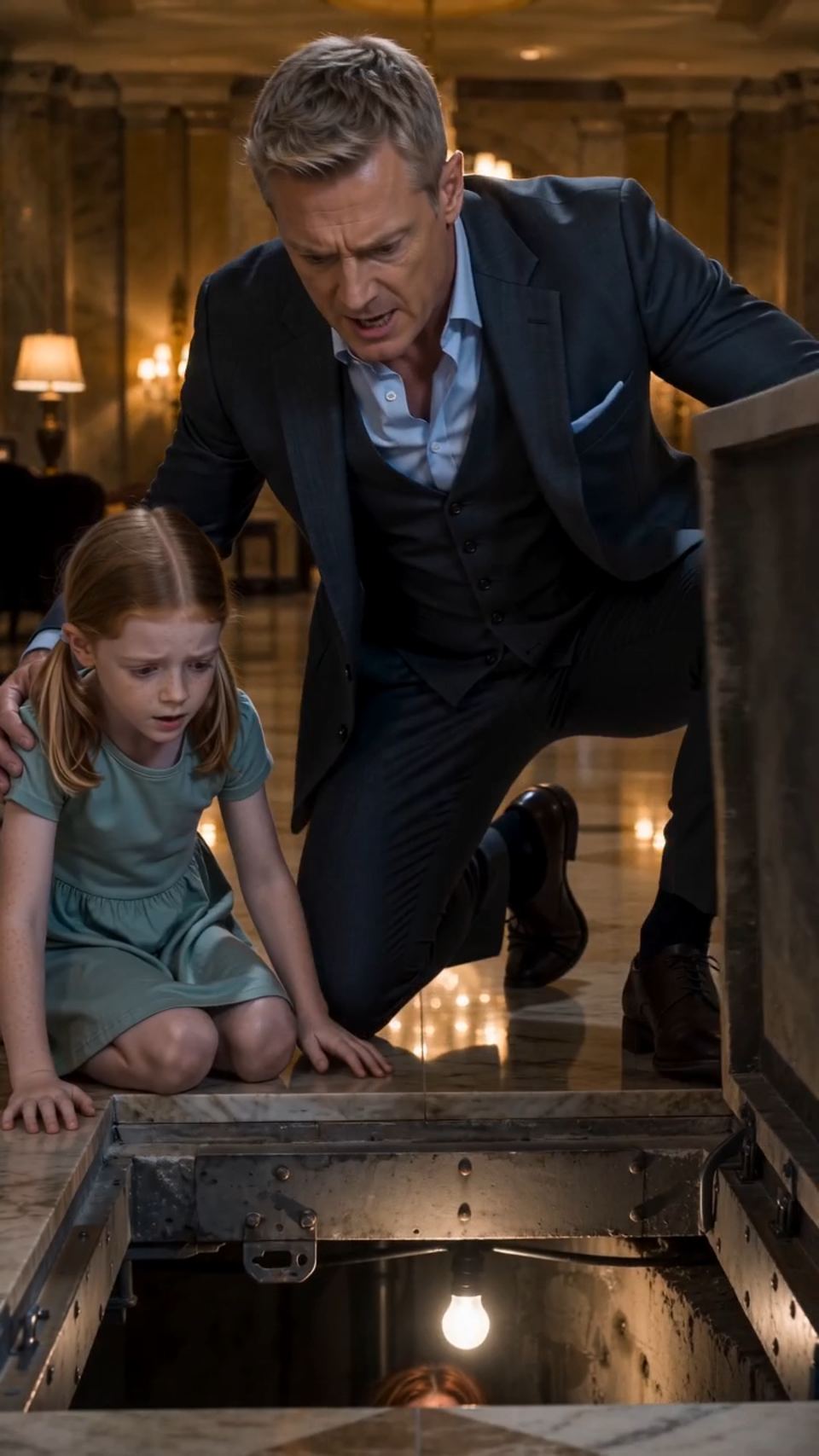
“Dad! There is someone down here! It’s Mommy!”
Six-year-old Ellie was on her knees on the polished marble floor, one hand trembling over the iron ring set into the stone.
At first, David almost smiled.
His daughter had always imagined things. Shadows in curtains. Faces in clouds. Once she had sworn their old Labrador was trying to talk.
But there was something different in her voice now.
Panic.
He crossed the kitchen fast, the crystal chandelier above them throwing warm gold light across the white floor. “Don’t be silly, sweetie. Mom is at work.”
Even as he said it, the words felt wrong.
Lena had texted him that morning. A normal message. Running late. Big client meeting. Kiss Ellie for me.
David dropped to one knee and grabbed the iron ring.
The marble hatch was heavier than he remembered. It scraped open with a brutal sound, revealing darkness, a narrow stair, and a weak swinging bulb below.
The basement had been sealed for years. It was little more than a storage pit left from the house’s original foundation.
He leaned forward.
Then he heard breathing.
Not his own.
His pulse slammed in his ears as he stared into the dim light below. A woman was curled in the corner, wrists bound with rope, her beige sweater filthy, her reddish-brown hair hanging over her tear-streaked face.
She looked up.
“David! Oh God, get me out!”
His whole body went cold.
It was Lena.
Not possible.
He had spoken to her that morning.
He had seen her leave for work.
Ellie started crying behind him. “Daddy, help Mommy.”
David rushed down the steps, hands shaking so hard he nearly fell. As he reached Lena, she pulled back in terror and whispered, “Don’t touch me until you tell me one thing.”
Her eyes locked on his.
“Who is the woman wearing my wedding ring?”
David froze, still kneeling in the dark.
For one wild second, David thought Lena had hit her head.
Then he saw the deep rope marks on her wrists. The dirt on her sweater. The truth in her eyes.
He cut her free with the utility knife he kept on a shelf near the stairs. Lena couldn’t stand at first. Her legs gave under her, and he had to half-carry her into the kitchen while Ellie sobbed and clung to her mother’s side.
Lena held their daughter so tightly Ellie whimpered.
“I thought you were gone,” Lena whispered into her hair.
David grabbed his phone. “I’m calling the police.”
Lena’s hand shot out and caught his wrist. “No. Not yet.”
He stared at her. “You were tied up in our basement.”
“I know where I was.” Her voice was raw. “I also know that if we call too soon, she may disappear.”
“Who?”
Lena looked at him like she was trying to decide whether he was a fool or a liar.
“The woman who took my place.”
Ellie was too young to understand, but not too young to feel fear. David led her to the den, turned on cartoons, and came back to the kitchen. Lena sat wrapped in a blanket, pale and shaking, but her mind was clear.
“I left for work yesterday morning,” she said. “I never got there. A woman stopped me in the parking garage. She knew my name. She said you had collapsed.”
David went still. “Collapsed?”
“I got close enough for her to spray something in my face.”
He sank into the chair across from her. Yesterday morning. Not today. She had been gone for more than twenty-four hours.
“But I spoke to you.”
“No,” Lena said quietly. “You spoke to someone using my phone.”
David opened his messages with numb fingers.
There they were. Short texts. Familiar enough. Not too familiar.
Then he looked closer.
Lena always signed with a red heart.
Every message from “her” ended with a period.
Before he could speak, his phone rang.
The screen said: Lena.
And from the den, Ellie shouted, “Daddy! Mommy’s car is in the driveway!”
“You spoke to someone using my phone.”
David looked from the ringing phone to the front window, where a woman in Lena’s coat was walking to the door.
David’s first instinct was to lock the door.
His second was to open it and demand the truth.
Instead, he stepped aside from the window and whispered, “Stay here.”
Lena rose anyway, one hand braced on the table. She looked weak, but there was steel in her face David had not seen in years.
The key turned in the front door.
The woman entered with a leather tote on her shoulder and Lena’s scarf around her neck. She called out, cheerful and ordinary, “Traffic was awful. Did Ellie eat?”
Then she saw Lena standing in the kitchen.
Everything stopped.
The tote slid from her hand and hit the floor.
Up close, the resemblance was shocking. Same height. Same hair color. Similar build. But not exact. This woman’s jaw was sharper. Her eyes darker. Her freckles painted on too lightly, as if someone had copied them from memory.
Ellie appeared at the den doorway and stared. “Why are there two mommies?”
The woman looked at the child, and something like pain crossed her face.
David stepped in front of Ellie. “Who are you?”
The woman’s shoulders dropped. “My name is Mara.”
Lena gripped the counter. “Why me?”
Mara swallowed. “Because he said it had to be you.”
“Who?” David asked.
She looked at him with a tired, haunted expression. “Your father.”
The room seemed to tilt.
David’s father had been dead for eleven months.
“No,” David said. “That’s impossible.”
Mara gave a short, broken laugh. “I met Richard Hale three weeks before he died.”
Lena stared at David. He stared back, both of them lost.
Mara slowly reached into her coat pocket. David tensed, but she only pulled out an old photograph.
She set it on the marble island.
It showed a much younger Richard standing beside a teenage girl with dark eyes and a defiant mouth.
Mara.
On the back, in Richard’s unmistakable handwriting, were four words:
My daughter. Keep hidden.
“My name is Mara.”
Lena’s hand began to shake as she turned the photograph over again and again.
The police came an hour later.
This time Lena let David call.
Mara did not run. That changed everything.
She sat at the dining table with her hands visible, as if she had rehearsed surrender before she ever came through the front door. Lena sat across from her, still wrapped in a blanket. David stood between them, not from anger now, but because he no longer understood where he belonged.
Mara told them the story in pieces.
Her mother had worked as a cleaner in a hotel outside Baltimore thirty-four years ago. Richard Hale had stayed there for months while building a real estate project. He promised help. Then he disappeared.
Years later, when Mara tracked him down, he was old, sick, and terrified his respectable life would crack open. He begged her not to contact David. He paid for an apartment. Sent money. Kept her hidden, just as he had written on the back of the photograph.
When Richard’s health failed, Mara went to see him one last time.
“He said he wanted to make things right,” she said. “But not publicly. Never publicly.”
Lena’s face hardened. “So he asked you to kidnap me?”
Mara looked horrified. “No. He asked me to watch your family after he died. He said David was fragile. That he couldn’t survive another loss.”
David let out a bitter breath. “Another loss?”
Mara looked at him carefully. “He said your mother didn’t leave. She tried.”
David’s knees nearly gave way.
His mother had vanished when he was eight. Richard had told him she abandoned them.
Mara reached into the leather tote and took out a cassette tape and a folded paper.
“The woman who attacked Lena wasn’t me. It was Paula, your father’s housekeeper. She said if Lena disappeared for a while, I could step in. She said Richard had promised I belonged here too.”
Lena stared. “She locked me in that cellar.”
“Yes,” Mara said. “And when I realized what she’d done, I came here to tell the truth.”
David unfolded the paper. It was an address.
A care home in Vermont.
At the bottom, in his father’s handwriting: Eleanor Hale. Tuesdays by the window.
His mother was alive.
“Your mother didn’t leave. She tried.”
David looked up from the note, and for the first time in forty years, hope frightened him more than grief.
The trip to Vermont took six hours and a lifetime.
Lena insisted on coming.
So did Ellie, who sat in the back seat with her stuffed rabbit and asked questions no adult could answer cleanly. Mara followed in her own car after giving a full statement to police. Paula was arrested before noon. She had confessed faster than anyone expected. Richard had promised her money if she helped “manage” the family after his death. Instead, she had built her own desperate plan from his secrets.
The care home was small, quiet, and filled with winter light.
David almost turned back at the door.
Lena touched his arm. “Whatever happened, you deserved the truth.”
A nurse led them to a sunroom.
An elderly woman sat by the window with a blanket over her knees, silver hair brushed neatly back. Her hands were thin. Still. Waiting.
David knew her at once.
Not from memory, exactly. From the shape of his own face. From the old ache in him that had always belonged to someone.
“Eleanor?” he asked.
She turned slowly.
For one terrible second, her eyes were empty.
Then they filled.
“David,” she said, as if his name had been resting in her mouth for decades.
He fell to his knees beside her chair.
Richard had told everyone she ran off. The real story came later from records, nurses, and Eleanor herself in fragments. After a breakdown following her sister’s death, Richard had placed her in treatment. When she improved and wanted to come home, he signed papers that moved her farther away and told their son she was gone. It was easier for him. Cleaner.
Lena wept quietly. Mara stood in the doorway, crying too.
Ellie walked up to Eleanor and placed a small hand on hers. “I’m Ellie. I found Mommy in the floor.”
Eleanor gave a shaky laugh.
That laugh broke something open in all of them.
Months later, the marble hatch was gone. David had the floor sealed. Not to hide what happened, but to end it.
On Tuesdays, they drove to Vermont together.
Sometimes Eleanor remembered everything.
Sometimes only their names.
Mara came often. Not as an intruder. As family, awkward and real.
One spring afternoon, Ellie looked up at David and said, “Grandma likes the window because she can see us arriving.”
David smiled through sudden tears.
“Yes,” he said. “And this time, we came back.”
“And this time, we came back.”
Outside the window, Eleanor lifted her hand before they even reached the door.
Để lại một bình luận