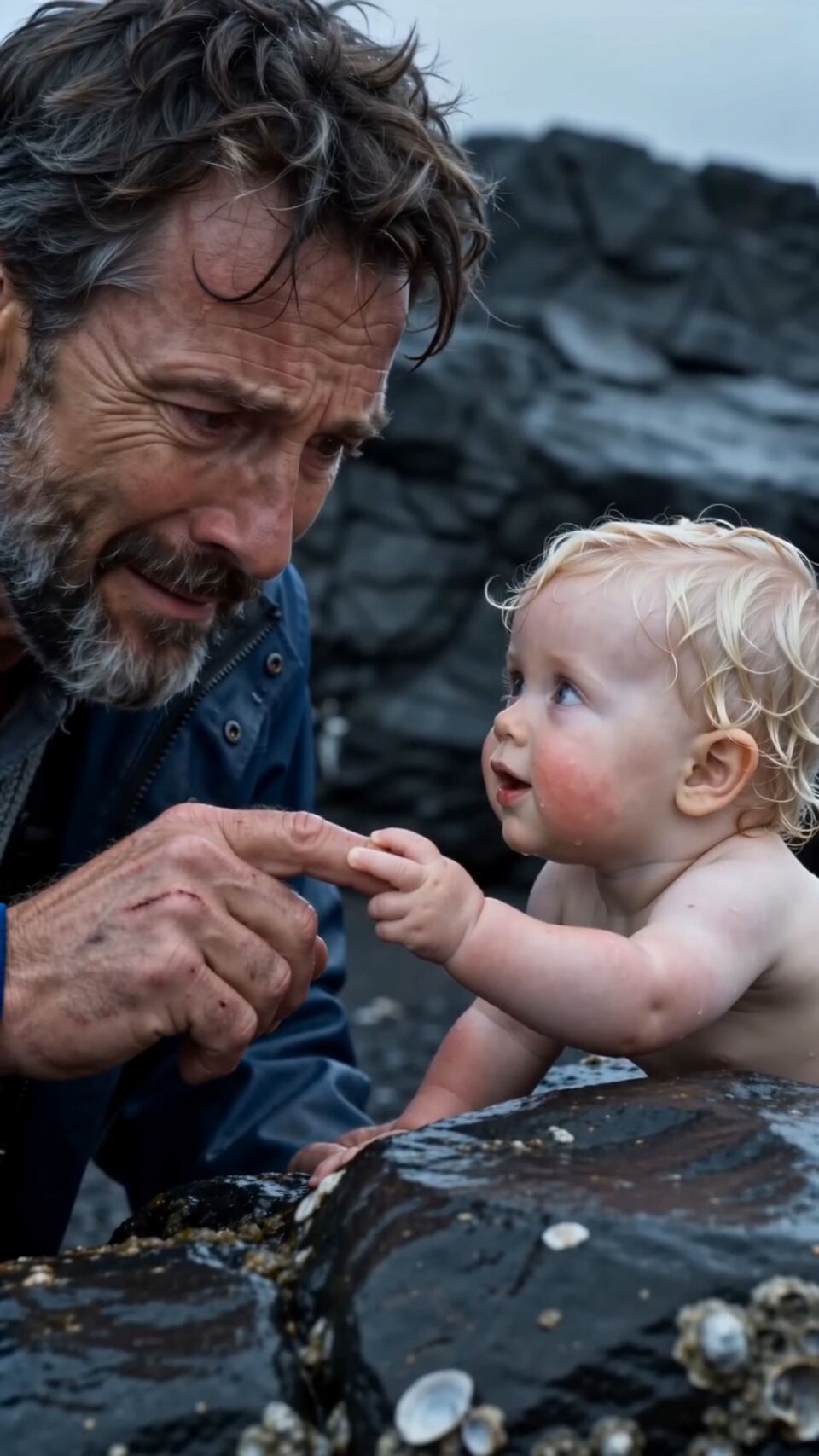
“Oh my God…”
Erik Nilsen had seen storms tear nets apart, watched boats vanish into fog, and once pulled a dead seal from the rocks with his own hands.
Nothing had prepared him for the baby lying on the black coast stones.
Her wet platinum curls clung to her forehead.
And below her tiny sweater, half-hidden by the tide, was a silver-blue tail that flicked weakly against the rock.
The child lifted her head and stared at him with wide green eyes, as calm as if she had been waiting for him all along. Then she made a soft sound, more curious than afraid.
Erik looked behind him. No boat. No footprints. No person in sight.
Only the orange buoy wedged between the stones, battered and old, as if it had washed up with her.
His rough hand hovered in the air.
“Is this real?”
The question came out in a whisper, almost lost beneath the wind.
The baby reached for him.
That simple touch hit him harder than any wave.
Erik had lost his wife, Solveig, three years earlier. He had never had children. He had spent months learning how to live inside his own silence.
He noticed then that the orange buoy had a name scratched into it.
LINA.
Before he could turn it over, a voice shouted from the cliff path.
“Erik? What are you doing down there?”
He looked up.
A woman in a dark raincoat stood above him, one hand gripping the railing. He recognized her at once. Mara, the village nurse.
But when she saw the baby, her face changed completely.
Not surprise.
Fear.
And that was when Erik understood this child was not only lost.
She was being searched for.
Mara came down the path slowly, as if every step cost her something.
Erik stood with the baby pressed against his chest, wrapped now in his wool jacket. The child had stopped crying the moment he held her. Her small fingers curled into the fabric at his shoulder.
“Where did she come from?” Mara asked.
“I found her on the rocks,” Erik said. “There was no one else.”
Mara’s gaze kept moving to the tail, then away again.
“Did anyone see you?”
“No.”
That answer seemed to relieve her and frighten her at the same time.
She knelt, keeping her distance. “Erik, listen to me. You need to bring her to the clinic. Right now.”
“Why are you looking at her like that?”
Mara hesitated.
The baby made a small sound and opened her hand. Inside her palm was a shell, white and spiral-shaped, too perfect to be natural. Erik had not seen it before. Maybe she had been clutching it all along.
Mara’s face went pale.
“That shell,” she said.
“Do you know it?”
“I know who may be looking for her.”
Erik felt his jaw tighten. “Then say it.”
Mara stood, suddenly unable to meet his eyes. “Her mother disappeared six months ago near the outer cove. The whole village heard the rumors. Some said she drowned. Others said she ran.”
“Her mother?”
Mara nodded once. “A foreign woman. Alone. She had the same eyes.”
Erik looked down at the baby.
The child had fallen asleep against him, trusting as a lamb.
Mara took a breath. “If people find out what she is, they will panic. And if the wrong people hear about her first…”
She stopped.
“Wrong people?” Erik said.
Before she could answer, headlights cut through the rain at the top of the cliff road.
A black van.
Not a fishing truck. Not a delivery van.
It rolled to a stop and stayed there, engine running.
Erik felt the baby stir in his arms.
Mara went rigid.
Then the side door of the van opened, and a tall man in a long dark coat stepped out holding a folder sealed in plastic.
He called down to the rocks.
“We were told to find the child.”
Erik moved before he thought.
He backed into the shadow of the cliff wall, one arm around the sleeping baby, the other raised instinctively in front of her. Mara grabbed his sleeve.
“Don’t let them take her yet,” she said.
“Who are they?”
“I don’t know,” she whispered. “But they came to the clinic yesterday asking about an infant with a tail.”
Erik stared at her. “And you didn’t tell me?”
“I didn’t know if I should. I was trying to keep her safe.”
The man on the cliff path started down with careful, measured steps. He looked too calm for someone bringing bad news.
“My name is Owen Vale,” he called. “I’m from the maritime registry. The child belongs in protective custody.”
Erik barked a bitter laugh. “Protective custody? She was left on a rock in the rain.”
Owen stopped a few feet away. His eyes dropped to the baby, then to the orange buoy tucked under Erik’s arm.
“That buoy,” he said quietly. “Where did you get it?”
“She was lying beside it.”
Owen’s expression changed for the first time. Not surprise. Recognition.
He opened the folder and pulled out a photograph sealed in a clear sleeve.
Erik saw a woman standing on a dock in a long blue coat, one hand resting on her stomach. Her face was tired but proud.
“Her name was Elin Svala,” Owen said. “And she left this child with instructions.”
Mara frowned. “Left her? Where?”
Owen did not answer at once. He held up another page. It was a handwritten note, stained by seawater.
If anything happens to me, take my daughter to the man who kept the orange buoy.
Erik stared at the words until they blurred.
“I never saw this woman,” he said.
Owen looked at him. “She knew you anyway.”
The baby shifted and opened her hand again. The white shell slid into Erik’s palm.
On the underside was a tiny engraving.
E.N.
Erik’s breath caught.
Mara touched her mouth. “Those are your initials.”
Erik remembered the buoy. Years ago, he had carved E.N. into it while repairing a broken mooring line for a stranger at the harbor. A woman with black hair had thanked him and asked his name.
He had forgotten her face.
But she had not forgotten him.
Owen lifted his chin. “There is more. The child’s mother is not the only one who left a message.”
He pulled out one final page and turned it toward Erik.
It was a birth record.
And the father’s name on it was written in Erik’s own handwriting.
Erik could only stare.
“No,” he said, though the word sounded weak even to him. “That isn’t possible.”
“It is,” Owen replied. “We checked the ink, the clinic stamp, and the witness signature. You signed this twelve years ago.”
Mara looked from one man to the other. “You have to explain that.”
Erik shut his eyes.
Then memory came back in broken pieces.
A storm. A ferry delay. A night in the harbor shelter after a rescue effort. A woman crying because she had no family, no papers, and no place to go. He had given her dry clothes, hot tea, and the only spare room at the fisherman’s hostel. She had told him her name was Elin. He had never thought of himself as important enough to remember.
But she had.
And now the child in his arms was looking up at him with his same green-gray eyes.
He swallowed hard. “I didn’t know.”
“I believe you,” Owen said. “But someone else will not.”
That someone arrived an hour later.
A white SUV stopped above the cliff, and a man in a tailored coat stepped out with two officials from child services. He carried himself like the rules belonged to him.
“Mr. Nilsen,” he said, “you are being asked to release the child immediately.”
Erik tightened his hold. “No.”
The child woke at his voice and began to cry, a frightened little sound that made his chest ache.
Mara stepped forward. “She’s exhausted and cold. If you take her now, she will panic.”
“We have procedures,” the man said.
“Then follow them after you hear me out,” Erik snapped.
He lifted the orange buoy.
“This was with her. It has my initials on it. There is a note from her mother. And if your procedures can’t wait ten minutes, then they are not meant to protect children.”
No one answered.
Then Owen spoke.
“There is another issue. Elin was not fleeing alone. She was hiding the baby from her former partner. A man named Henrik Soren. He has been asking about the child since last winter.”
Mara went pale again. “Henrik is in the village?”
Owen nodded. “He checked into the harbor inn last night.”
Erik looked down at the baby, then toward the road where the van had disappeared.
For the first time, the danger was no longer abstract.
It had a name.
And it was close.
By dawn, the storm had passed.
The sea looked almost innocent, silver under a washed-out sky. Erik stood outside the small cliff house with the baby asleep against his shoulder, while Mara packed warm blankets and formula into an old canvas bag.
No one had taken the child away.
Not yet.
Owen had persuaded the officials to wait for the family hearing at the town hall. Henrik Soren had been found at the harbor inn and was under watch. The village had begun to wake up, whispering, watching, wondering.
But the truth was no longer hiding.
Inside the house, Erik placed the orange buoy on the table beside the shell with the engraved initials. He had spent the night reading Elin’s note again and again.
Take my daughter to the man who kept the orange buoy.
She had trusted a memory.
And that memory had brought her child home.
When the baby stirred, Erik smiled despite the tears in his eyes.
“I think she knows you now,” Mara said quietly.
“She knows I’m the one who stayed.”
At the town hall, Henrik tried to claim he had only wanted to protect Elin. But the records Owen brought, along with messages Elin had hidden with a friend in Bergen, told a different story. He had tried to force her to give up the baby after learning the child was born with a rare genetic condition tied to the sea. Elin had run.
Not because she was unstable.
Because she was brave.
The hearing ended with the baby placed temporarily in Erik’s care until the court could review everything. The officials called it temporary custody.
Erik called it mercy.
Weeks later, the village gathered at the harbor for the baby’s naming ceremony. Not a legal one. A promise one.
Mara held the child while Erik spoke.
“We called her Lina,” he said, glancing at the buoy on the bench beside him. “Because she was found by the sea, but she belongs to people who stayed.”
The crowd fell quiet.
Then a woman Erik had never seen before stepped forward from the back of the pier. She wore a blue scarf and carried an envelope.
“I was Elin’s closest friend,” she said. “She asked me to bring this if anything ever happened.”
Inside was one last photograph.
Elin, smiling weakly on a dock.
And beside her, a little boy of about eight, looking through a window from inside a care home.
“He was kept there by Henrik’s family,” the woman said. “Elin was searching for him too.”
Erik looked up sharply.
The baby in his arms began to laugh in her sleep.
And for the first time, the sea did not feel like an ending.
It felt like a beginning.
Để lại một bình luận